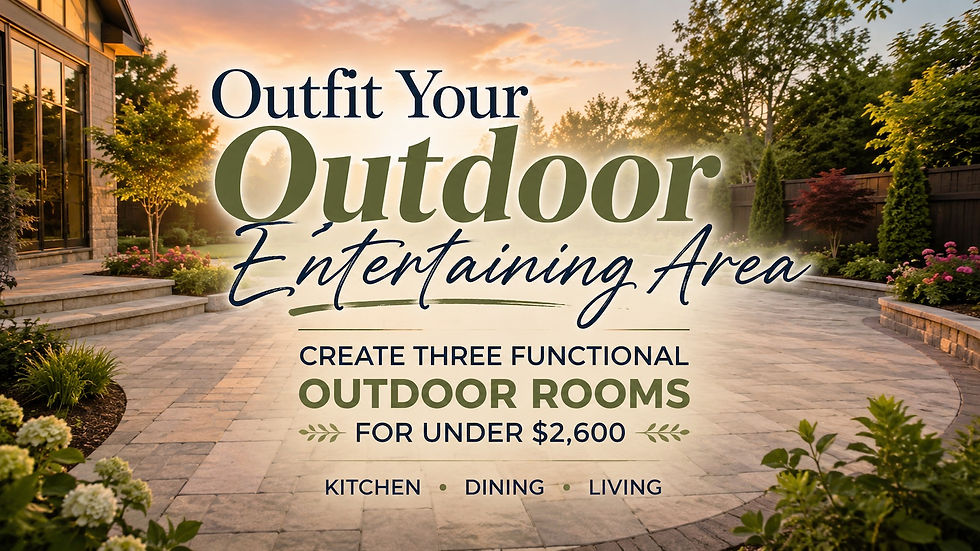
Why Outdoor Rooms Work Better When They Are Built Around Zones, Not Furniture

BEFORE YOU START
Many outdoor living spaces are designed one furniture purchase at a time.
A dining table is added first. Then a few chairs. Later, a fire feature. Maybe a conversation set. Eventually, the space fills with individual pieces that looked appealing when they were purchased.
Yet despite the investment, many outdoor spaces still feel disconnected.
The reason is surprisingly simple.
People do not experience outdoor rooms as collections of furniture. They experience them as collections of activities.
Dining. Relaxing. Cooking. Gathering around a fire. Watching children play. Enjoying a morning cup of coffee. Hosting friends.
The most successful outdoor spaces are often built around these activities first and the furniture second.
Before evaluating layouts or shopping for new pieces, take a few moments to think about how you naturally use your outdoor space.
Ask yourself:
What activities happen most often outdoors at your home?
Where do guests naturally gather when they visit?
Which areas feel comfortable and inviting today?
Which parts of the yard tend to go unused?
Are you trying to create one large entertaining area or several smaller destinations?
The answers frequently reveal that the best outdoor rooms are not necessarily the ones with the most furniture. They are the ones where every area has a clear purpose.
As you read through this guide, think about the functions you want your outdoor space to support. Once those zones are identified, choosing furniture becomes much easier.
A beautiful outdoor room does not begin with a furniture set.
It begins with a reason to be there.
That may sound simple, but it changes the entire way a backyard is planned.
Many outdoor spaces are built backward. Someone buys a dining table, a sectional, a fire pit, a grill, or a few chairs because those are the pieces that seem to belong outside. Then they place them on the patio and hope the space starts to feel finished.
Sometimes it does.
More often, the yard looks furnished but does not feel fully usable.
The table may be too far from the kitchen. The seating may face the wrong direction. The grill may sit outside the natural path of conversation. The fire pit may look attractive but have awkward clearance. The umbrella may shade the wrong part of the patio. The serving area may not exist at all, which means food, drinks, napkins, and extra plates end up scattered wherever they fit.
This is why outdoor rooms work better when they are built around zones instead of furniture.
A zone is not just a spot where something sits. It is a place with a purpose. A dining zone supports meals. A lounge zone supports conversation. A cooking zone supports food preparation. A shade zone supports comfort. A serving zone supports flow. A fire zone supports warmth and gathering. An atmosphere zone supports the feeling that the backyard is intentional rather than improvised.
At Ashford Terrace, we think the strongest outdoor spaces are not necessarily the largest, the most expensive, or the most fully furnished. They are the spaces where each area has a clear job, each piece supports that job, and guests can understand how to use the space without being told.
That is the quiet power of zoning.
It turns a backyard from a collection of outdoor furniture into a place people naturally settle into.
Furniture Answers “What?” Zones Answer “Why?”
Furniture planning asks, “What should we put here?”
Zone planning asks, “What should happen here?”
That difference matters.
If you begin with furniture, the decision often becomes about size, style, material, and price. Those things are important, but they do not always answer the deeper question of how the space will function. A beautiful table does not guarantee that people will eat outside. A large sectional does not guarantee that conversation will feel natural. A fire pit does not guarantee that the area will be comfortable.
If you begin with zones, the planning becomes more honest.
You might realize that the patio does not need a large dining table because your family mostly uses the backyard for drinks and conversation. You might discover that a lounge area will not work well until you solve shade. You might see that the grill is technically in a fine spot, but there is nowhere nearby to set trays, tools, or finished food. You might realize that the missing piece is not more furniture, but a serving surface, better lighting, or a clearer path from the house.
Zones make outdoor planning less about filling space and more about supporting use.
That is especially helpful for real households with real budgets. Most people cannot build a complete outdoor room all at once. Zoning helps you choose what matters first. Instead of buying scattered pieces because they look nice, you can build the backyard in layers that make sense.
A dining zone this year. A shade solution next year. A serving station later. Or a lounge zone first, then a fire feature, then lighting.
The order becomes clearer because each purchase is attached to a purpose.
The Dining Zone: More Than a Table and Chairs
A dining zone is one of the easiest outdoor areas to understand, but one of the easiest to under plan.
Most people know they need a table and chairs. But a dining zone also needs space for movement, access to food, some form of comfort, and enough atmosphere to make the meal feel worth lingering over.
The first question is not “How large of a table can we fit?”
The better question is “How do meals happen outside?”
If food comes directly from the kitchen, the dining zone may need to sit close to the house. If most meals come from the grill, the table may need to relate more closely to the cooking zone. If guests serve themselves buffet-style, the dining zone may need a nearby console, cart, or serving table so the main table does not become overcrowded. If the patio gets intense sun during dinner, shade may be part of the dining zone, not a separate decision.
A good dining zone gives people room to pull out chairs, pass behind seated guests, set down serving pieces, and move comfortably between the table and the rest of the space.
This is where proportion matters. A table that technically fits but leaves no breathing room can make the whole backyard feel tight. A slightly smaller table with better clearance may feel more generous because people can actually use it comfortably.
The dining zone should also have visual grounding. A rug, potted plants, lanterns, string lights, a table runner, or a simple centerpiece can help define the area. These details do not have to be elaborate. They simply tell the eye, “This is where the meal happens.”
That clarity makes even a modest patio feel more intentional.
The Lounge Zone: Where People Stay After the Meal
The lounge zone is where the outdoor room often becomes part of everyday life.
Dining may bring people outside, but seating often keeps them there.
A lounge zone might be a full sectional, but it does not have to be. It could be two comfortable chairs and a side table. It could be a loveseat, coffee table, and garden stool. It could be a bench with cushions near a planter wall. It could be a small seating nook under an umbrella with a place for coffee and a book.
The important thing is not the number of seats. It is whether the arrangement invites people to settle.
A good lounge zone supports conversation, rest, and casual use. People should be able to sit facing each other or at least comfortably angled toward one another. They should have somewhere to set a drink. The seating should not block the path from the house, dining area, or yard. Cushions should feel welcoming but not so precious that the area becomes difficult to use.
In smaller backyards, the lounge zone may be the entire outdoor room. That can work beautifully. A compact patio with two chairs, a small table, a rug, lanterns, and potted plants may be more useful than a crowded attempt to include dining, cooking, and fire in a space that cannot comfortably support them.
In larger backyards, the lounge zone helps prevent the yard from feeling like one oversized dining patio. It gives people somewhere to move after the meal. It creates a softer, more relaxed destination. It also supports everyday use when no one is hosting at all.
A lounge zone is often the reason people step outside on an ordinary evening.
That makes it one of the most important areas to plan well.
The Cooking Zone: Keep It Functional, Not Isolated
Outdoor cooking areas can become impressive very quickly.
Built-in grills, prep counters, outdoor refrigerators, pizza ovens, storage cabinets, sink stations, and grill islands all have their place. But even a simple freestanding grill is part of a zone, and that zone needs to work in relation to the rest of the backyard.
The most important thing about a cooking zone is that it should support the person cooking without isolating them from the gathering.
A grill tucked into an awkward corner may be functional in a technical sense, but if the host is separated from everyone else, the layout can make outdoor cooking feel like a chore. On the other hand, a grill placed too close to seating may create smoke, heat, crowding, or safety concerns.
The cooking zone needs balance.
It should be close enough to the dining or serving zone that food can move easily. It should have a landing surface nearby for trays, utensils, sauces, and finished dishes. It should allow the cook to participate in the gathering without forcing guests to stand in the cooking path. It should also respect ventilation, heat, and safe clearance.
For many households, the most valuable upgrade to a cooking zone is not a bigger grill. It is a better prep or landing surface. A stainless prep cart, outdoor-safe table, or compact counter area can change the entire experience because it gives the cooking process somewhere to happen.
A cooking zone does not need to be a luxury outdoor kitchen to work well.
It needs to make preparing and serving food easier.
The Serving Zone: The Quiet Hero of Outdoor Entertaining
The serving zone is often forgotten because it is not as glamorous as the dining table, fire feature, or lounge area.
But in real hosting, it can be the difference between calm and clutter.
A serving zone gives food, drinks, plates, napkins, pitchers, utensils, and extras a place to land. It keeps the dining table from becoming overcrowded. It keeps guests from clustering in the doorway. It helps people serve themselves without asking the host where everything is.
This zone can be as simple as an outdoor bar cart, a narrow console table, a folding serving table dressed with a tray, a beverage tub on a stand, or a built-in counter near the grill.
The best location depends on the flow of the backyard.
A drink station often works well near the edge of the gathering, where guests can access it without interrupting the meal. A food serving station may belong between the kitchen or grill and the dining table. A dessert or coffee station might sit closer to the lounge area if people tend to move after dinner.
The serving zone should not block movement. It should not require guests to squeeze behind seated people. It should not be so far away that the host has to cross the yard repeatedly.
When placed well, a serving zone makes a backyard feel more generous because the host is not forced to improvise.
It is also one of the most attainable ways to improve an outdoor space. You do not have to replace major furniture to improve flow. Sometimes one well-placed serving surface makes the entire patio work better.
The Shade Zone: Comfort Is Part of the Design
Shade is not an afterthought.
It is part of the architecture of outdoor comfort.
A backyard can have beautiful furniture and still go unused if the sun makes the space uncomfortable. Harsh light, heat, glare, and exposure can decide where people sit more powerfully than style ever will.
A shade zone may be created by a pergola, umbrella, shade sail, gazebo, covered porch, tree canopy, outdoor curtain system, or privacy screen. The form matters less than the comfort it provides.
The key is to plan shade where people actually need it.
A dining table that receives full afternoon sun may need an umbrella more urgently than a new table runner. A lounge area that becomes too hot by mid-afternoon may need a pergola or shade sail before additional seating. A west-facing patio may need privacy screens or curtains that soften both sun and exposure.
Shade also helps define zones visually. A pergola can make a dining area feel like an outdoor room. A cantilever umbrella can identify a seating area. Outdoor curtains can make a covered space feel softer and more private. Even a single large umbrella can tell guests where the comfortable part of the patio begins.
In a staged photo, shade may look optional.
In daily life, it often determines whether the backyard gets used.
The Fire Zone: A Natural Place to Gather
Fire has a way of giving an outdoor space a center.
A fire zone can be casual or refined, large or compact. It may include a propane fire table, gas fire pit, wood-burning fire pit, tabletop fire bowl, or outdoor fireplace. What matters is not how dramatic it looks, but whether it creates a comfortable and safe gathering point.
A fire zone works best when seating is arranged with intention. Chairs should be close enough to feel connected, but not so close that heat becomes uncomfortable. There should be room to walk around the fire feature. Side tables, stools, or small surfaces can make the area more usable for drinks, blankets, or snacks.
Fire is especially useful for evening-centered households. If the backyard is mostly used after work, after dinner, or during cooler seasons, a fire zone may bring more value than a larger dining setup.
But fire should not be forced.
In a very small patio, a compact tabletop fire bowl may be more appropriate than a large fire pit. In a narrow space, a freestanding patio heater might provide warmth without requiring a central fire layout. In a larger yard, a fire zone can sit apart from the dining zone and become a second destination.
The best fire zones feel inviting rather than theatrical.
They make people want to pull up a chair.
The Movement Zone: The Space Between the Spaces
The most overlooked outdoor zone is the one that remains empty.
Paths, clearances, and transitions are part of the design.
People need to move from the house to the table, from the grill to the serving area, from seating to drinks, from the patio to the yard, and from the gathering back inside. If every inch of the backyard is filled, the space may look complete but feel difficult.
A movement zone does not need to be labeled. It just needs to exist.
There should be enough room behind dining chairs. Doors should open freely. Guests should not have to step around planters or furniture legs to reach the table. A serving cart should not sit in the exact place where everyone naturally walks. A fire feature should not interrupt the only clear path across the patio.
Good movement makes outdoor hosting feel effortless.
Bad movement creates constant small interruptions.
This is why negative space is not wasted space. It is the room that allows the outdoor room to function.
In small backyards, preserving movement may mean choosing fewer pieces. In medium spaces, it may mean placing zones along the edges rather than filling the center. In larger yards, it may mean using pathways, lighting, rugs, or planters to connect separate areas without crowding them.
The space between zones matters as much as the zones themselves.
The Atmosphere Zone: The Details That Make It Feel Finished
Atmosphere is what makes an outdoor space feel intentional.
Lighting, planters, rugs, pillows, lanterns, garden stools, water features, storage benches, and decorative accents do not usually create the primary function of the backyard. But they make the space feel cared for. They soften hard surfaces. They connect separate areas. They add warmth, texture, and personality.
The mistake is trying to use atmosphere before function is clear.
A rug cannot fix seating that blocks the door. String lights cannot solve a patio that is too hot to use. Pillows cannot make an oversized table fit better. Decor works best when it supports a zone that already has a purpose.
Once the zones are clear, atmosphere becomes much easier.
A dining zone may need a table runner, lanterns, planters, or overhead string lights. A lounge zone may need an outdoor rug, side tables, pillows, and a storage bench for throws. A fire zone may need low lighting, comfortable seating, and a place to keep blankets. A serving zone may need trays, beverage tubs, or a simple lamp-style lantern to make it feel deliberate.
These finishing details should not make the backyard feel over-designed. They should make it feel settled.
The best outdoor atmosphere says, “This space is ready for people.”
Zones Make Small Backyards Feel Bigger
Zoning is not only for large outdoor spaces.
It may matter even more in small ones.
A small patio can feel cramped when it tries to hold too many unrelated pieces.
But when it has one clear zone, it can feel surprisingly complete. A bistro dining zone with a rug, planters, and wall lights can feel intentional. A two-chair lounge zone with a side table and lanterns can feel peaceful. A compact serving zone near the door can support casual hosting without overwhelming the patio.
The key is to avoid miniaturizing every possible outdoor room.
A small backyard does not need a tiny dining area, tiny lounge area, tiny fire area, and tiny bar area all squeezed together. It needs the right primary zone and maybe one supporting function.
For example, a small dining zone might include a round table, four chairs, an outdoor rug, two planters, and a tray that can serve as a drink station. A small lounge zone might include two chairs, a shared side table, a lantern, a throw, and potted greenery. A small shade zone might be a simple umbrella that makes the entire patio usable.
When a small space has a clear purpose, it feels larger because it is easier to understand.
Clarity creates spaciousness.
Zones Make Larger Backyards Feel More Connected
In larger backyards, zoning solves the opposite problem.
Instead of crowding, the challenge is often disconnection.
A big backyard can feel empty if furniture is spread too far apart or if each area looks unrelated to the next. People may not know where to gather. The dining table may feel isolated. The fire pit may feel too far from the house. The lounge area may look attractive but unused.
Zones give a larger backyard rhythm.
A dining zone near the kitchen can connect to a serving zone. A path can lead toward a lounge zone. A fire zone can become the evening destination. Lighting can visually tie the areas together. Repeated materials, planters, rugs, or accent colors can make the whole space feel cohesive without making it match too perfectly.
A large backyard should not feel like one giant patio.
It should feel like a series of places that belong together.
That is what zoning provides.
Build the Outdoor Room One Zone at a Time
One of the most practical benefits of zoning is that it allows the backyard to grow over time.
You do not need to finish everything at once.
You might begin with the dining zone because meals are your priority. Later, you add shade because the afternoon sun becomes the biggest limitation. Then you add a serving surface because hosting feels awkward without one. Over time, lighting, planters, and a small lounge area complete the experience.
Or you might begin with seating. Then a fire feature. Then side tables. Then a rug, lanterns, and storage for throws.
This staged approach is not a compromise. It is often the smartest way to build an outdoor space because each decision is informed by use. You learn what the backyard needs by spending time in it.
The result is usually more personal, more functional, and more attainable than buying everything at once.
Zones help you avoid scattered purchases because each new piece has to answer a clear question:
What zone does this support?
If the answer is unclear, the purchase may not be necessary yet.
A Better Way to See the Backyard
The next time you look at your outdoor space, try not to see it as a blank area waiting for furniture.
See it as a series of possible experiences.
Where would morning coffee feel best? Where would dinner feel natural? Where would guests gather before the meal? Where does shade fall? Where does the breeze move? Where could food be served? Where would evening light make people want to linger? Where does the path from the house already want to go?
These questions reveal the zones before you buy anything.
And once you understand the zones, the furniture choices become much clearer.
A backyard does not need to contain every outdoor feature to feel complete. It needs the right areas, scaled honestly, arranged thoughtfully, and supported by pieces that make those areas easier to use.
That is why outdoor rooms work better when they are built around zones, not furniture.
Furniture fills space.
Zones create purpose.
And purpose is what makes an outdoor room feel like part of the home.